Ras al Muajjiz crude terminal, Yanbu: berth occupancy shifts from intermittent to near-continuous
Ras al Muajjiz crude terminal (Petroline terminus), near Yanbu, Saudi Arabia
Snapshots are curated, event-dated observations from open satellite data. They document specific events; they are not the systematic instrument records above. Every image carries its provenance in-frame.
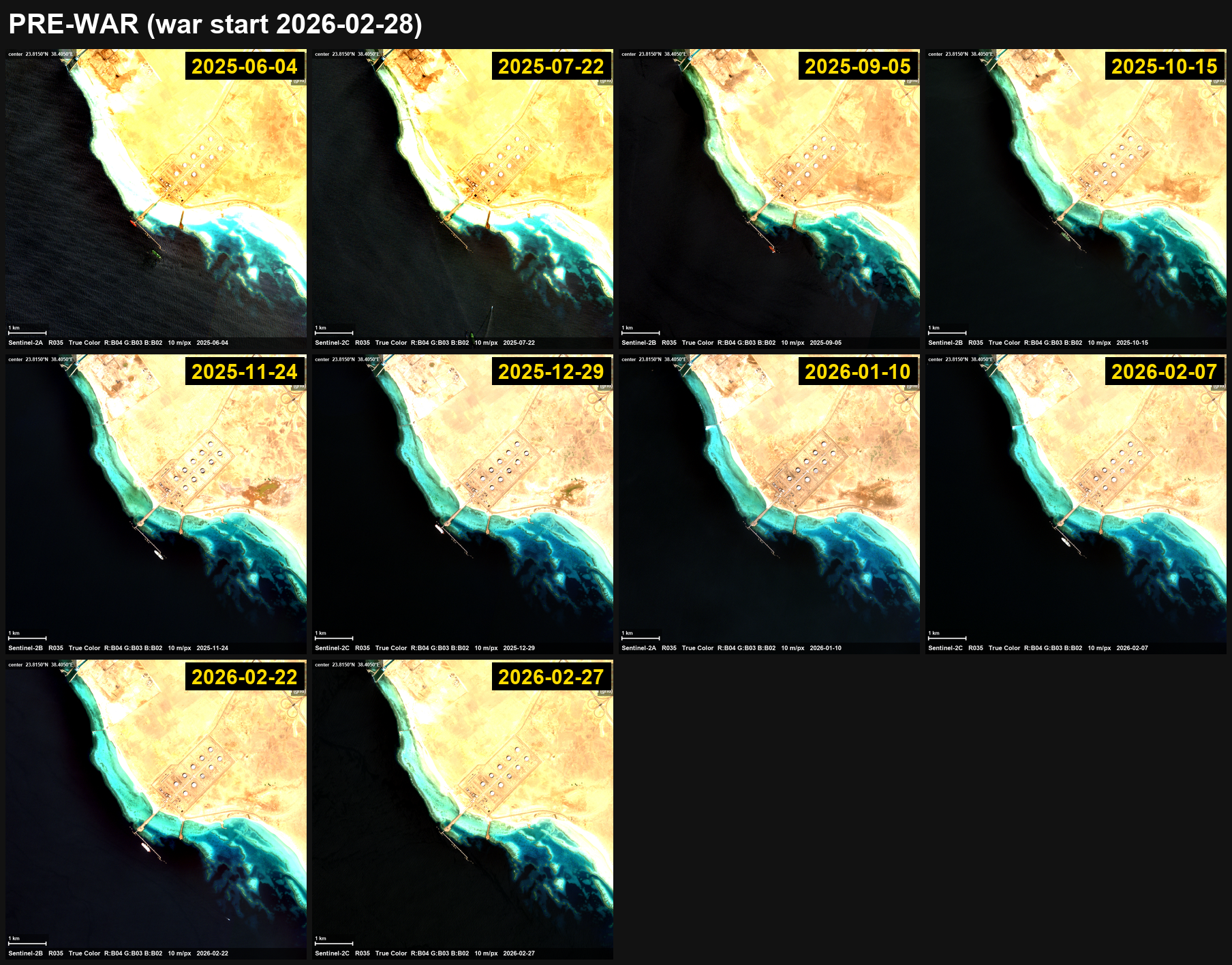
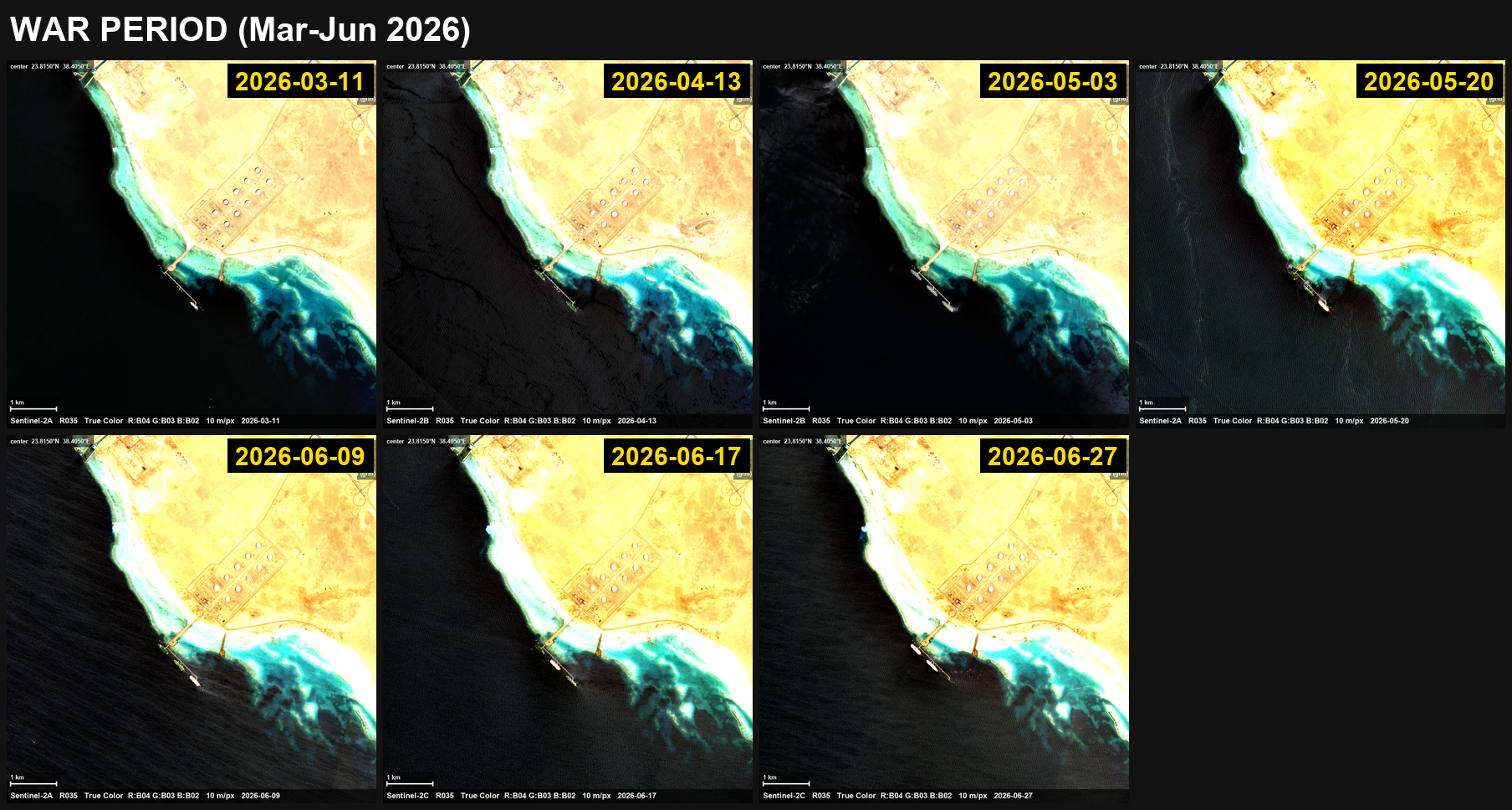
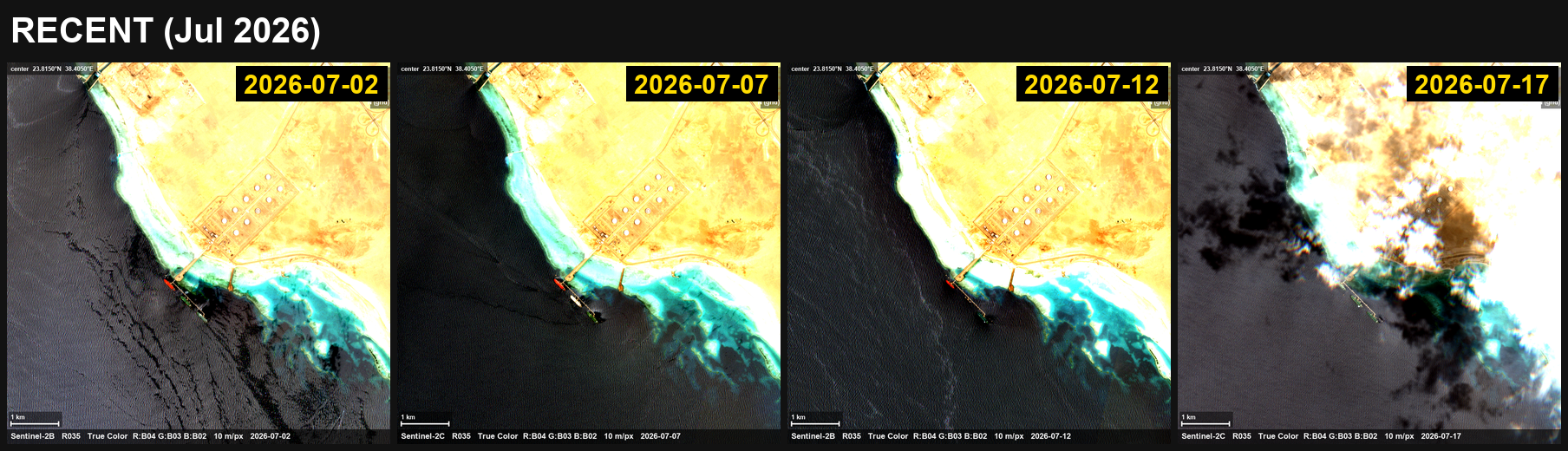

Caption
Twenty-one Sentinel-2 passes over the Ras al Muajjiz crude terminal near Yanbu, Saudi Arabia — the Red Sea terminus of the East–West (Petroline) pipeline — from June 2025 through 17 July 2026. Before the war began in late February 2026, a tanker was at the loading berth on six of ten passes. During the war the berth is occupied on five of seven readable passes (two uncertain), and on every readable July pass — with a second hull working alongside on 7 July and a possible second on 2 July. No anchorage queue appears on any date. The pattern is consistent with the pipeline carrying barrels displaced from Gulf routes; it is not the queue-forming signature of a terminal loading at full capacity. Imagery: Copernicus Sentinel-2 (open data) via Microsoft Planetary Computer, rendered and annotated by NewsplanetAI.
What this imagery does not establish
Each pass is a single instant — loadings between passes are invisible, so these are berth-occupancy rates, not ship counts or throughput. The series establishes direction, not magnitude: 21 of roughly 66 available passes are read, too few to quantify the change. No vessel identity or class is claimed from these pixels, and where cargoes go after loading is not observable here. Colors are not comparable between frames (each is stretched independently).