Week of July 20–26, 2026
TL;DR: In a war fought over oil, both sides have carefully spared the oil. Five months in, the export terminals are standing and the water plants aren't — and the only energy infrastructure anyone is destroying is the routes around the chokepoint, not the chokepoint itself.
THE WEEK
On 25 July, Ukraine struck the Caspian Sea. Its security service named the targets: the Filanovsky offshore platform, operated by Lukoil, and two cargo ships, Port Olya 2 and Begey, which it says were moving military cargo between Russia and Iran. Iran confirmed part of it in the way adversaries do — by protesting. Tehran summoned Ukraine's chargé d'affaires, called the attack criminal, said one sailor was killed and others injured aboard what it describes as a commercial vessel, and asked the European Union to act. Kyiv says military cargo. Tehran says commercial hull. Russia's defence ministry has said nothing at all about the platform.
Both governments agree a strike happened and describe it completely differently. What is not in dispute is the water it happened in: the Caspian is the one sea Iran and Russia share, and the corridor across it — Astrakhan and Makhachkala to Anzali and Amirabad — is a documented arms route. Two wars that have been described as parallel now have a shared casualty.
The same weekend, the American air campaign against Iran paused for two consecutive nights, the first break since strikes went continuous on 6 July. A defence official described operations as "on a hold." The Vice President and the Chairman of the Joint Chiefs had raised concerns about munitions and interceptor stockpiles days earlier.
PATTERN, AND PHASE SHIFT
Almost everything reported as a turning point in this war is a repetition. Distinguishing the two is most of the work.
Pattern: Iran under sanctions, which it has been for decades. Ships running dark at Hormuz, which they have done for at least a decade. Iranian threats to close the strait, which are forty years old. And the strike-pause-strike oscillation, which has run since February — a ceasefire on 7 April that collapsed by the 22nd, a memorandum signed 17 June and voided 17 July, and now a two-night hold. Every prior pause resumed.
Phase shift: 28 February, when the United States opened the war and killed Iran's Supreme Leader on the first day. 13 July, when the four-year Saudi–Houthi truce broke and a second front opened. 14 July, the naval blockade. 17–18 July, when both sides began striking civilian water and power. 21 July, when Kazakhstan's export pipeline stopped for the first time. 25 July, the Caspian.
We can now show this distinction rather than assert it. Working from Global Fishing Watch's satellite radar archive, which classifies vessel detections by whether they match a broadcast AIS signal, the Strait of Hormuz has produced two different signatures at two different kinds of event. When sanctions arrive, total vessel presence holds or rises while the broadcasting population falls and the unmatched population rises by almost exactly as much — the same shape after the US reimposed sanctions in November 2018 and after UN snapback returned on 27 September 2025, seven years apart. When the war arrived in March 2026, presence itself fell, and both populations fell together.
Sanctions change who can be seen. War changes who is there. Reported as one number, they are indistinguishable; reported as shapes, they are not the same event at all.
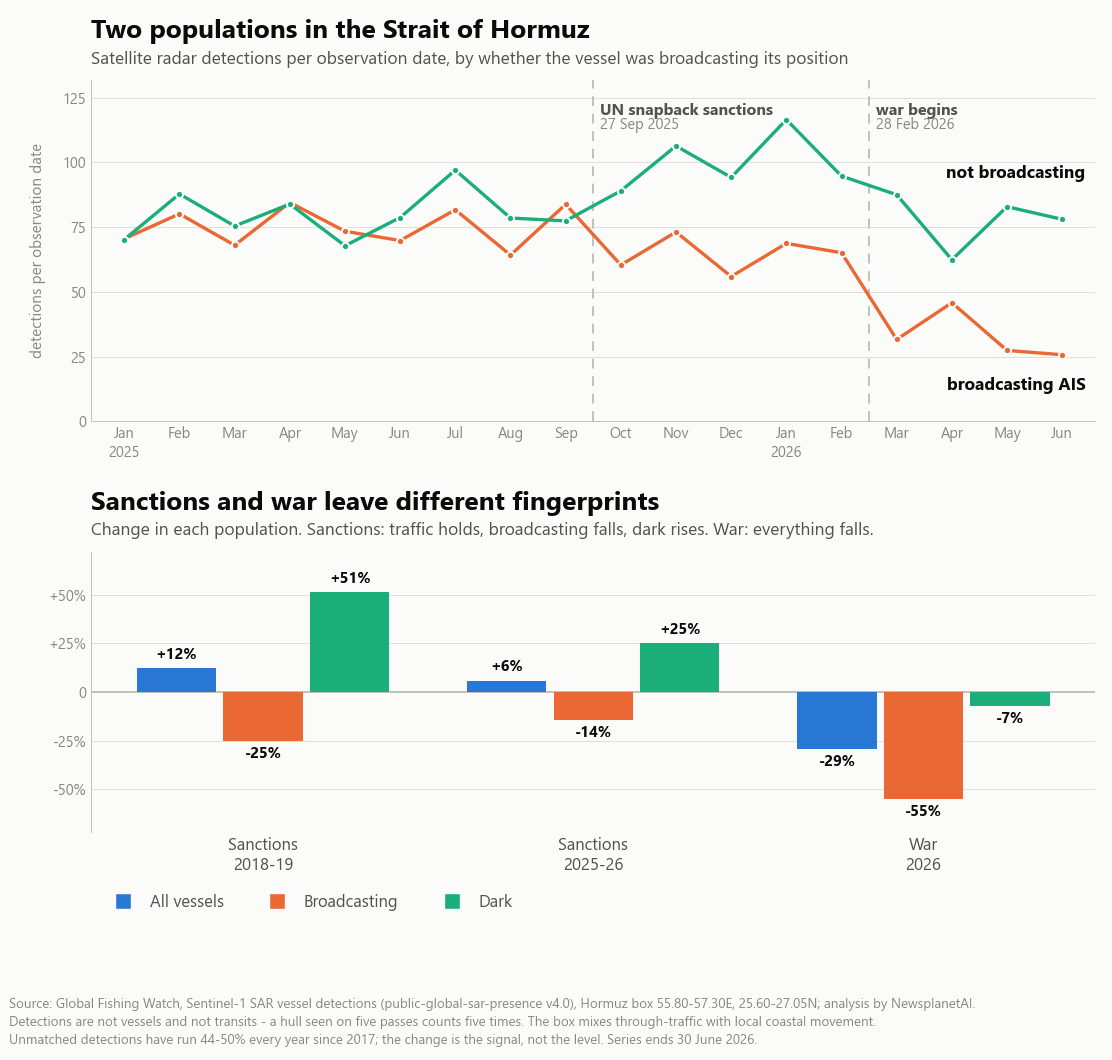
Satellite radar detections in the Strait of Hormuz, per observation date. The broadcasting population falls from about 70 to about 26; the non-broadcasting population holds near 78. Detections are not vessels and not transits. Vessel detection data: Global Fishing Watch.
Two cautions on our own instrument, because they cut against us. Roughly 44–50% of vessel detections at Hormuz have gone unmatched every year since 2017 — dhows, fishing boats and service craft that never carried transponders — so the dark level is ordinary and only the change carries information. And 2019 was darker than 2025. There is nothing unprecedented about opacity in this water.
WHAT THEY AREN'T BOMBING
Here is the pattern nobody is naming.
In March, the US Air Force struck Kharg Island — the terminal through which roughly nine-tenths of Iran's oil exports pass — hitting more than ninety military sites and deliberately leaving the oil infrastructure intact. Satellite imagery showed tankers loading there the same week. Our own imagery shows three ships at the T-Jetty on 16 March, days after the raid, and a ship still alongside on 20 July, six days after the blockade was reinstated. President Trump stated the logic on the record: he would reconsider sparing Kharg "if Iran or anyone else interferes with the passage of ships through the Strait of Hormuz."
That is not restraint. It is a hostage.
Iran's own bypass terminal tells the same story from the other side. Across 33 Sentinel-2 passes between 28 February and 18 July, our imagery analysis found no large-footprint damage at the Kuh-e Mobarak terminal at Jask — the export point of the pipeline that reaches open water without entering the strait. That null has limits we should state: at ten-metre resolution we would see burnt tanks, a collapsed pier or an oil slick, and we would not see a precision hit on a pump or a manifold. Intact is not the same as unstruck. But by separate reporting, American strikes destroyed the Bunji desalination plant roughly 65 kilometres up the same coast, leaving some ten thousand people without water by an Iranian provincial official's account.
The same choice runs in the other direction. Iran struck Kuwait's desalination-and-power complex and its Subiya power station — a country drawing around 90% of its drinking water from desalination — and left Kuwait's oil terminals alone. The Gulf Cooperation Council called those strikes war crimes.
So what is actually being destroyed? The detours.
Iran drone-struck Saudi Arabia's Petroline pumping station — the pipeline that carries crude around Hormuz to the Red Sea — on 7 April, the same day it signed a ceasefire. The Houthis declared an embargo on Saudi shipping on 20 July and put missiles at Yanbu, that pipeline's terminus, on the 25th; they were intercepted. A fire at Aramco's Jizan refinery the day before was corroborated independently by thermal and imagery evidence, though Aramco and the Saudi government have published no damage assessment. And Ukrainian drones hit tankers at the CPC loading terminal at Novorossiysk between 17 and 20 July, after which Kazakhstan halted the pipeline entirely.
A chokepoint is worth exactly what the alternatives cost. So the alternatives are the target set, and the chokepoint is left working — because you cannot collect a toll on rubble.
THE INSTRUMENTS DISAGREE, AND THAT IS THE FINDING
AIS-visible tanker transits through Hormuz collapsed in July: 23 on the 1st, five on the 8th, one on the 12th, and between one and four for the rest of the month. Note the date. The 12th is the day after the container ship GFS Galaxy was hit and the Revolutionary Guard declared the strait closed — and two days before the naval blockade was reinstated. The declaration emptied the visible lane. The navy arrived afterwards.
Against that, every downstream gateway ran near normal in the same week. Measured against each strait's own 2025 average, for 14–19 July: Malacca at 92%, the Cape of Good Hope 93%, Lombok and Sunda 95%, the Korea Strait 97%. Suez at 114% and Bab el-Mandeb at 122% — both above normal, both measured in the last week before the Houthi embargo took effect on the 20th. Hormuz read 8%.
Asia's oil is arriving. Whether it is Gulf oil, the gateway cannot say — West African and Atlantic barrels cross Malacca too. But the arithmetic constrains it. If Gulf crude is a quarter to a third of Malacca's tanker traffic, a genuine collapse at Hormuz should have dented Malacca by 23–28%. The dent is 8%. Somewhere between half and two-thirds of the expected shortfall simply is not there — absorbed by some mix of oil still moving unseen, oil substituted from elsewhere, and reserves being drawn down.
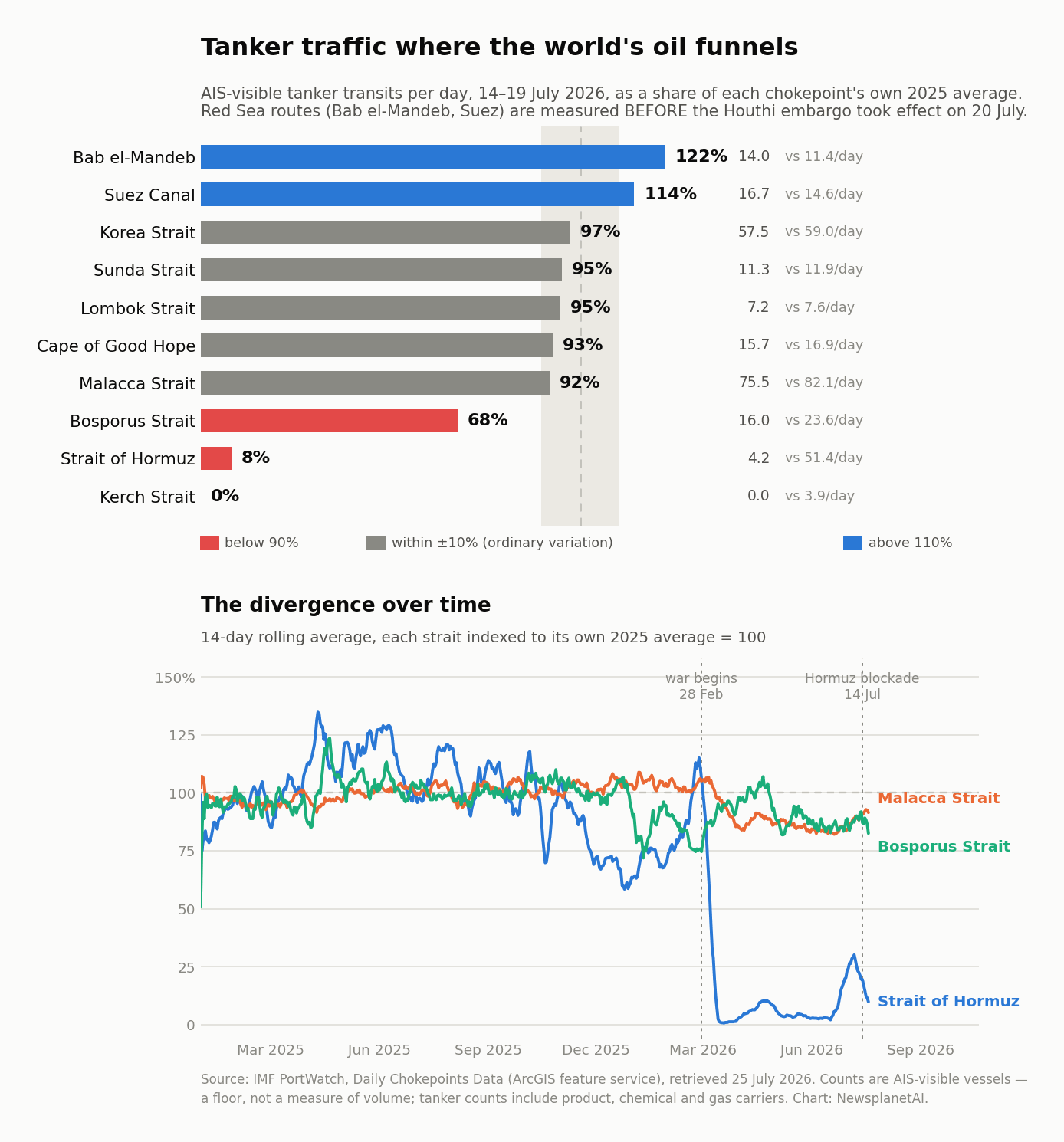
Tanker transits per day, 14-19 July 2026, against each chokepoint's own 2025 average. Red Sea routes are measured before the Houthi embargo of 20 July. Source: IMF PortWatch, queried directly.
The genuine contractions on the board are elsewhere and smaller: the Bosporus at 68% and the Kerch Strait at zero. Those are worth trusting precisely because they are hard to fake. The Bosporus is 700 metres wide at its narrowest, runs through a city of sixteen million, and lies entirely within Turkish waters under a pilotage regime nobody contests. You cannot hide a supertanker in downtown Istanbul.
And a large part of the compliant fleet has not gone anywhere — it is trapped. The International Maritime Organization planned to evacuate more than 11,000 seafarers from the strait; as of late July at least 6,000 remain aboard some 400 vessels, unable to leave. At least nine ships with 93 crew have been abandoned outright by their owners at Iranian ports. Five to six hundred commercial ships are caught up in the evacuation. They are moored behind the strait, inside the Gulf, loaded, waiting for a risk they can afford. Our own imagery shows what that risk looks like: a tanker burning south of Larak Island on 21 July.
THE LEDGER
Moody's Analytics puts the cost to American taxpayers and consumers at at least $132 billion. The Pentagon's own figures don't reconcile with that or with each other — $29 billion in direct military costs as of 12 May, $37.5 billion spent of an $87.6 billion supplemental as of 21 July. Brown University's tracker puts the extra fuel bill since 28 February at $61.7 billion, about $471 per household. Harvard's Linda Bilmes projects a long-run total above a trillion.
There is no published cumulative cost ledger. There is no published Defense Department casualty ledger for this war. And there is still no released investigation into the strike on a girls' school at Minab on the war's first day, which killed 156 people including 120 students, and which the Pentagon's own preliminary finding attributed to American forces. The Senate's deadline for that investigation expired on 20 July. Three ledgers a government would normally keep. All three absent, in the same war.
WHO PAYS
Kazakhstan fired no shots and is losing more oil production than either belligerent. Its main export route closed on 21 July when the CPC pipeline halted — roughly 1.5 million barrels a day, about 80% of its exports. Its alternatives run across the Caspian into a war zone or into a country under blockade, and together they can absorb 350,000 to 400,000 barrels a day. So it is shutting in wells instead.
Four days later, President Tokayev stood beside Vladimir Putin in Omsk and urged him to freeze the war in Ukraine and return to a revamped version of the 2022 Istanbul talks. It was the first time Kazakhstan has publicly called for a freeze rather than a settlement. Putin walked him through the military operation and said it was impossible.
China, meanwhile, is the one large buyer declining to pay the war's premium. Its June crude imports fell 41% year-on-year to the lowest level since 2016, and it is drawing on roughly 1.4 billion barrels of reserve rather than buy at wartime prices. The United States is drawing its own reserve for the opposite reason — the Strategic Petroleum Reserve stands at 311.4 million barrels, the lowest since 1983, with the weekly draw accelerating. One reserve is financing a war. The other is declining to.
And hull war-risk cover has gone from 0.25% of vessel value before the war to 3–8% now, with freight from the Gulf to Asia moving from about $40,000 a day to $220,000–300,000. Lloyd's underwriters have begun excluding vessels with any Saudi touchpoint from Red Sea cover. The war has not changed the flow. It has changed the rent.
THE BLIND SPOTS
Africa ran hot in our pipeline this week — 1.8 standard deviations above its own baseline, which is the inverse of its usual four-percent floor, and on inspection it is genuine rather than a single bandwagon story.
New IPC and World Food Programme figures put 7.8 million South Sudanese — 55% of the population — at crisis-level hunger or worse through July, with 73,300 in the catastrophic phase, a 160% increase on the previous estimate. In Sudan, the Rapid Support Forces' siege of El-Obeid continues without a ground assault; a two-wave attack near Berber killed 15 civilians on 24–25 July by the state government's account. The Democratic Republic of Congo's Ebola outbreak has passed 2,100 cases and 1,000 deaths, with 80% of new cases arising outside known transmission chains.
And the International Criminal Court removed its chief prosecutor on 24 July by a vote of 82 member states — the first such removal in the court's history. Karim Khan denies wrongdoing and calls the process unfair. Whatever the merits, the vacancy sits above active files on Sudan, Russia and the West Bank.
THIS WEEK IN HISTORY
On 26 July 1956 — seventy years ago today — Gamal Abdel Nasser spoke for three hours in Alexandria from notes on the back of an envelope. When he said the words "de Lesseps," an engineer named Mahmud Yunis began the takeover of the Suez Canal Company.
Britain, France and Israel answered with force that autumn, took the canal militarily, and were made to give it back. The canal stayed Egyptian. Britain finished the episode as something less than a great power.
It is the last time a state asserted sovereign control over a maritime chokepoint and a superpower coalition tried to reopen it by force. The force worked. The policy did not.
Historical data from The Time Detectives
LOOKING AHEAD
- 27 July: polls in Mirpur, the first stage of staggered elections in Pakistan-administered Kashmir, after 31 protest deaths and the proscription of the main protest platform.
- 28 July: the next IMF PortWatch chokepoint print. We have a prediction on the record: a Hormuz-to-Malacca voyage takes 11–12 days, so this print catches only the leading edge, and the 4 August print is the decisive one. If the oil has genuinely stopped, Malacca falls below 80% of its baseline. If it is moving unseen, Malacca holds near 92–95%. We will publish the outcome either way.
- 29 July: the weekly US petroleum report, and with it the SPR trajectory — the honest gauge of how long this can be financed.
- The tripwire worth watching: Iran has protested the Caspian strike, summoned Ukraine's envoy and appealed to Brussels. It has not retaliated. The first confirmed Iranian strike on Ukrainian territory or Ukrainian-operated shipping would stop these two wars being coupled and make them one.
CLOSING OBSERVATION
Five months of the most expensive air campaign in a generation has not moved the oil, and was never aimed at it. The terminals are standing on both sides because both sides need them standing — one to sell the crude, the other to keep the leverage that sparing it buys. What has been destroyed instead is everything around them: the pipeline that goes around, the terminal that loads the neighbour's barrels, the plant that makes a city's drinking water.
The molecules still move. The rent has been repriced, the fleet that carries it has changed, and the invoice has landed on a Kazakh oil field, six thousand sailors who cannot go home, and a household fuel bill four hundred and seventy-one dollars heavier. That is not a war for oil. It is a war over who gets to charge for it.
A note on method. The satellite radar analysis in this brief is our own, drawn from Global Fishing Watch's public Sentinel-1 archive, and it is a new finding rather than a reported one. Three things would refute it: if the sanctions signature fails to appear at control chokepoints we haven't yet tested for the 2018 episode; if the Hormuz decline turns out to be local coastal traffic rather than through-traffic, which our current box cannot separate; or if the 4 August Malacca print falls below 80%. Vessel detections are not vessels and not transits, and our observation window ends 30 June — the July collapse described above comes from IMF PortWatch, not from radar. Satellite vessel detection data courtesy of Global Fishing Watch.
Sources: IMF PortWatch (queried directly); Global Fishing Watch SAR (public-global-sar-presence v4.0); Sentinel-2 imagery analysis; UKMTO/Royal Navy SCCD; PBS NewsHour; Bloomberg; Reuters; gCaptain; Al Jazeera; CFR; Moody's Analytics via Fortune; Brown University Costs of War; Lloyd's Market Association; Baltic Exchange; EIA; IMO/UN News; OHCHR; NPR; IPC; WFP; WHO; UANI; CENTCOM statements; Kuwait government/KPC; GCC Secretariat; The Time Detectives.